Removing mold the right way
Mold remediation for Spokane homes, with the moisture source fixed first
Mold grows where water stays. We remove it under containment and help find the moisture that let it grow, because that is what keeps it from coming back.
- Answered 24/7
- Containment
- HEPA filtration
- Material removal
Quick answer
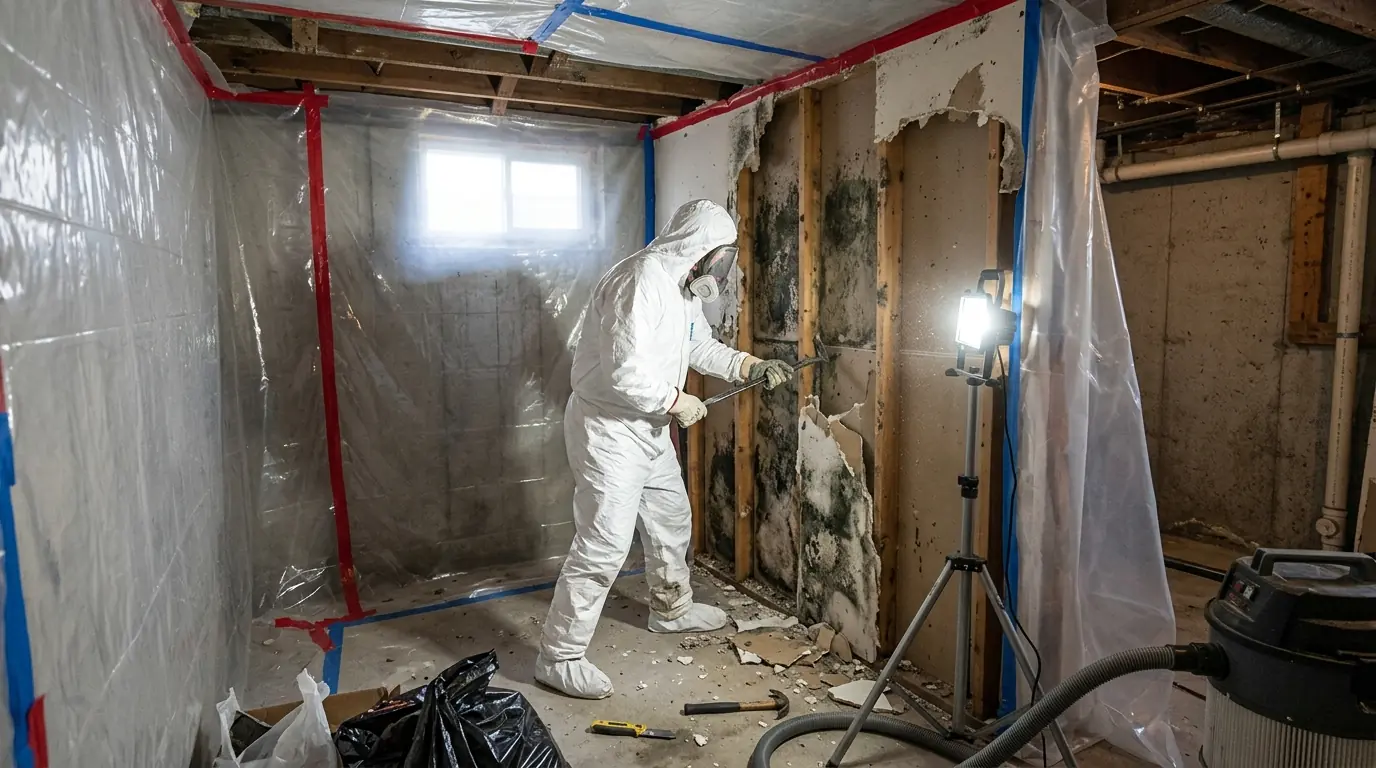
Mold remediation in Spokane means containing the affected area, filtering the air with HEPA equipment and removing or cleaning moldy materials so spores don't spread to clean rooms. Porous materials like drywall and insulation usually come out; solid wood is often cleaned. The moisture source has to be fixed, or the mold returns.
Updated October 2026
What remediation actually removes, and what it doesn't
Mold spores are in every house and all outdoor air, so no process makes a home spore-free. Remediation removes active growth and the materials it damaged, bringing the area back to normal background conditions.
The work follows a pattern. We isolate the area with plastic sheeting and keep it under negative air pressure so disturbed spores flow into a HEPA filter, not into the hallway. Porous materials with growth, such as drywall, insulation and carpet pad, are cut out and bagged. Semi-porous and solid materials like framing and subfloor are cleaned, sanded where needed and dried. Then comes the part that decides whether the job lasts: correcting the leak, condensation or humidity that started it, often traced with moisture mapping.
Cost
Typical mold remediation costs, nationally
This Old House's 2026 cost guide puts typical mold remediation at $1,200 to $3,750, with an average around $2,300, or roughly $10 to $25 per square foot. Treat that as a national planning range, not our price. Attic jobs often run $1,000 to $4,000 and crawl spaces $500 to $2,000 in the same guide, while whole-house remediation can reach $10,000 to $30,000.
Price follows the affected area, how much material comes out, access and whether rebuild is included.
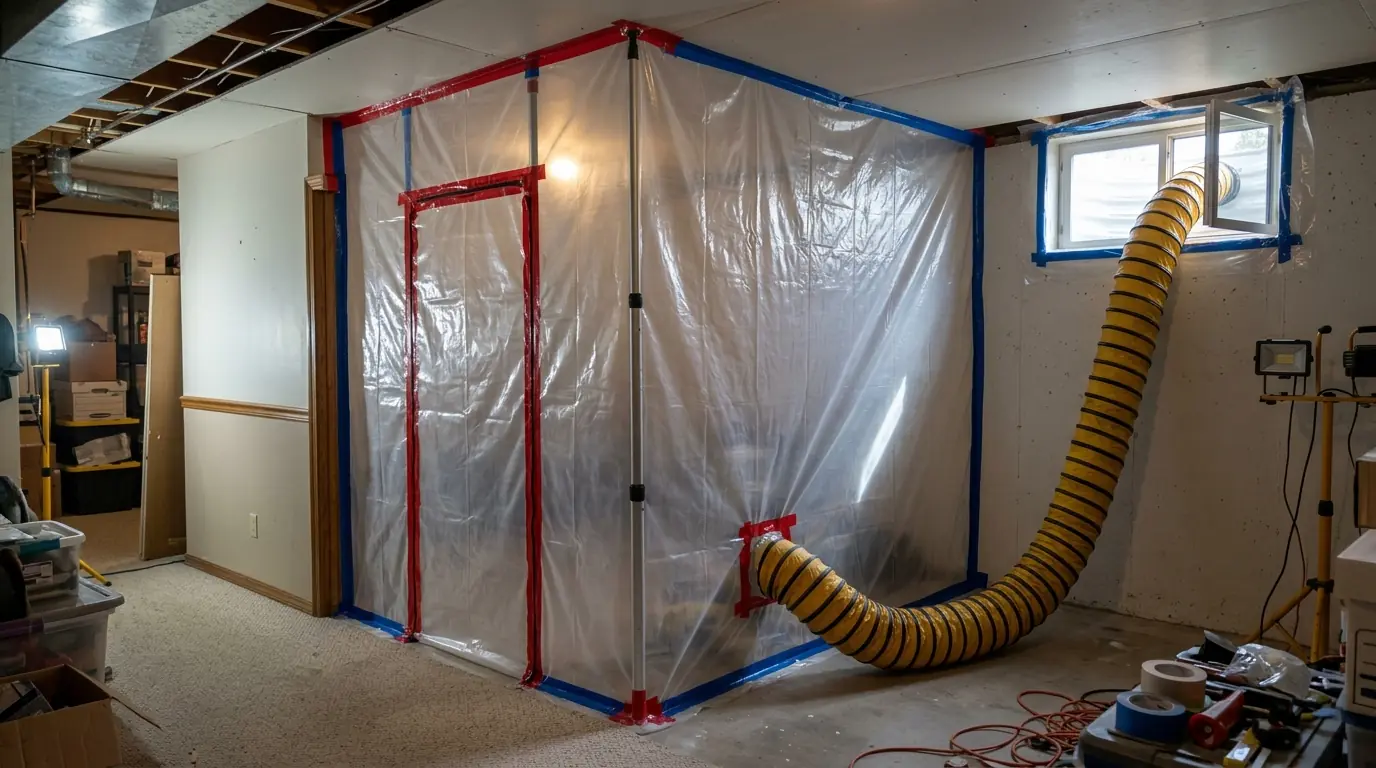
Containment to keep mold in one area
Cutting moldy drywall releases spores and dust. Without containment, that dust drifts through the house and lands on clean surfaces. For anything beyond a small patch, we build a plastic enclosure from floor to ceiling with a zippered entry, seal vents and doorways inside it, and cover the floor. A negative air machine pulls air out of the enclosure through a HEPA filter, so the air leak at any gap flows inward. Small patches may only need local sheeting; heavy contamination may get a second chamber for removing protective gear.
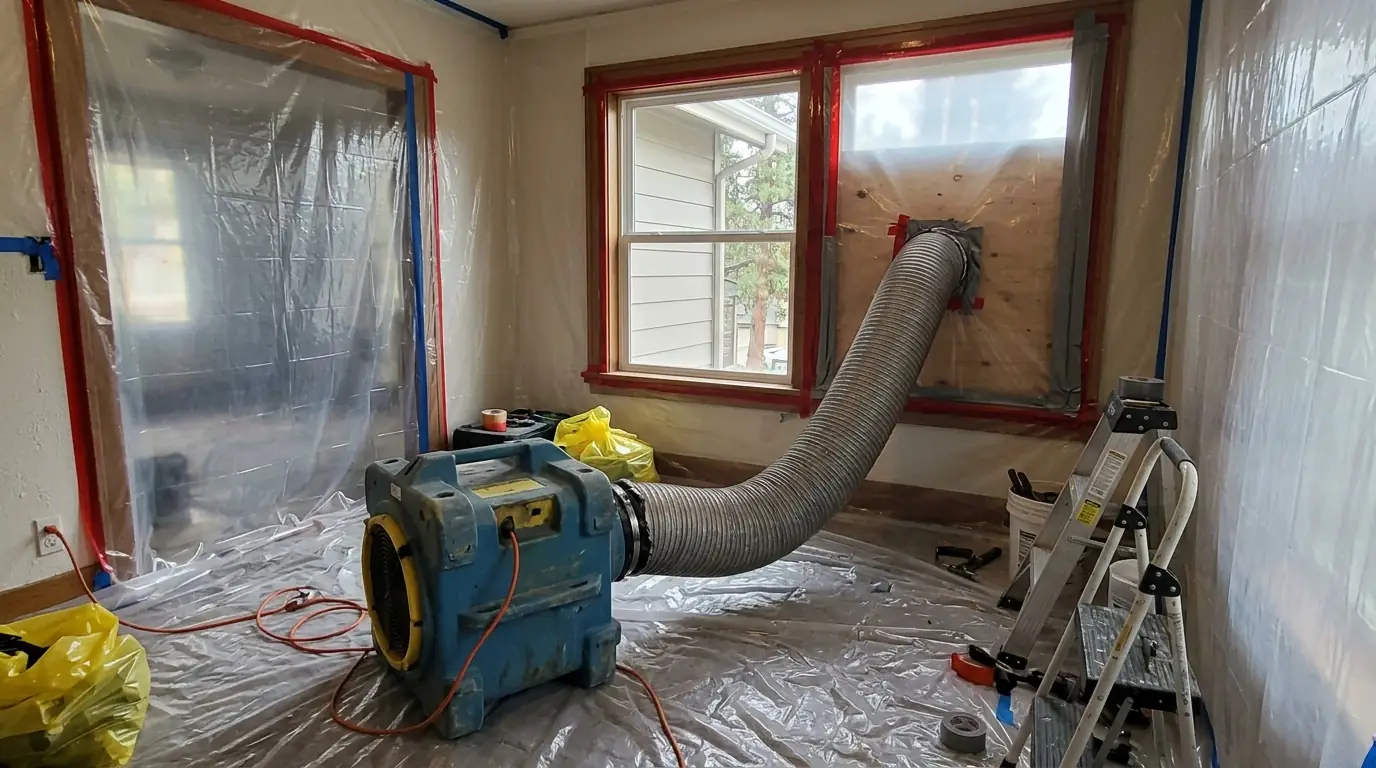
HEPA air filtration during the work
HEPA filters capture particles at the size of mold spores and the fine dust that comes off moldy drywall. We use them two ways. Negative air machines exhaust filtered air out of the containment, keeping it under slight negative pressure. Air scrubbers recirculate and filter air inside the work area to keep spore counts down while we cut and clean. After removal, every surface inside containment gets HEPA vacuumed before the final wipe-down, and the equipment runs until cleaning is done and the area is dry.
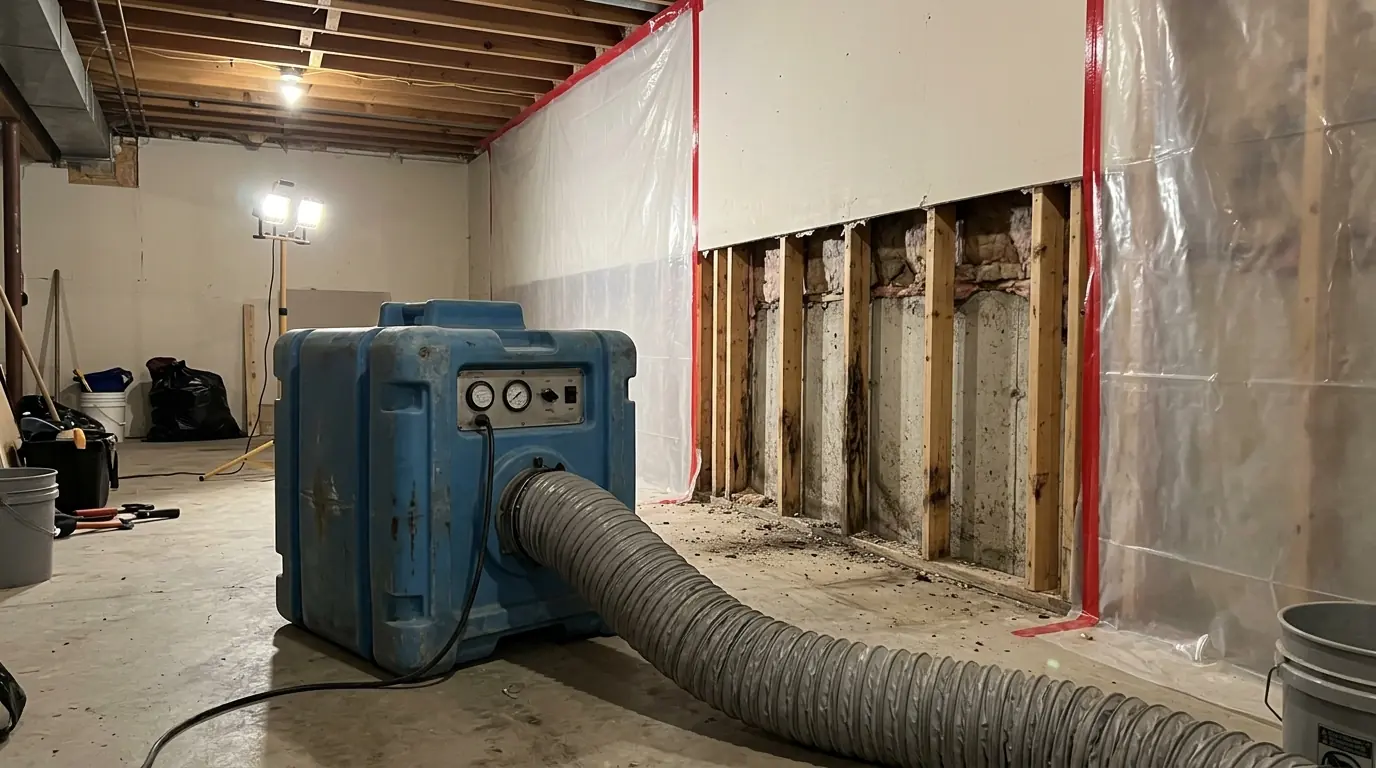
Drywall and material removal
Mold on drywall doesn't stay on the surface. It grows into the paper facing and the gypsum, so scrubbing the paint only hides it. We cut drywall back past visible growth, typically to clean material at least a foot or two beyond the edge, and check the back side of the cut. Wet or moldy insulation is bagged and removed. Studs and sheathing are usually saved: we HEPA vacuum, scrub or sand off surface growth, and confirm they're dry with a moisture meter before anything closes up. Carpet pad with growth gets thrown out; carpet sometimes too.
Looking at this mess right now?
Pick up the phone. A real person answers 24/7 and talks you through the next ten minutes.
What our mold remediation scope includes
The size changes, but the steps stay the same.
- Moisture mapping to find the source and the full extent of wet material.
- Containment with plastic sheeting, sealed vents and negative air pressure.
- HEPA air filtration running from setup through final cleaning.
- Removal and bagging of moldy drywall, insulation and carpet pad.
- Cleaning, sanding and HEPA vacuuming of framing and subfloor.
- Drying with dehumidifiers and moisture readings logged until materials are dry.
How a mold remediation job runs
- 01
Find the moisture
Meters and inspection show where water is coming from and how far it spread.
- 02
Contain the area
Plastic walls, sealed vents and negative air keep spores in the work zone.
- 03
Remove and clean
Porous moldy materials come out; framing is cleaned, sanded and HEPA vacuumed.
- 04
Dry and verify
Readings confirm materials are dry before anything closes up.
- 05
Correct the cause
The leak, condensation or humidity problem is fixed so mold has no reason to return.
Local conditions
Postwar basements in Comstock and around Manito
Comstock on the South Hill is mostly post-World War II houses with a handful from the early 1900s, and the streets around Manito Boulevard, laid out in 1907, carry mature trees. Basements in houses of that age were often finished well after construction, sometimes without a vapor barrier behind the drywall. That is a common setting for mold behind paneling or framed walls. When we work in Comstock or Manito/Cannon Hill, we open the bottom of basement walls before deciding the scope.
Signs a room may need mold remediation
Any one of these is worth a closer look.
A musty smell that won't clear
Persistent earthy odor in a closet, basement or behind furniture often means growth you can't see.
Spotting that returns after cleaning
Mold that comes back on a wall or ceiling usually has roots in the material or a moisture source behind it.
Stains near plumbing or windows
Discoloration around supply lines, toilets or window corners points to repeated wetting.
Bubbling paint
Water trapped behind paint lifts it and feeds growth.
Mold you can handle yourself and when to call
Small surface mold is often a homeowner job.
| Task | Doing it yourself | When we do it |
|---|---|---|
| A small patch on a window sill | Clean it, dry it, and watch for condensation. | When the sill wood is soft or stained deep. |
| Shower grout mildew | Detergent and a brush usually work. | When it returns behind the tile. |
| Mold on drywall | Scrubbing doesn't reach growth inside the gypsum. | Any patch bigger than a few square feet. |
| Mold after a leak | Small areas can be cleaned if the leak is fixed and things are dry. | When drywall or insulation stayed wet for days. |
Mold Remediation questions
No. Dead mold still stains and still sheds particles. Remediation physically removes growth and damaged materials, then cleans what's left. A spray can be one step, never a substitute for removal and fixing the moisture.
Often not. When growth is visible and the moisture source is known, testing rarely changes the plan. Testing helps when you smell mold but can't find it, or after remediation to confirm the area is back to normal.
Usually, once containment and negative air are set up and the work area is closed off. For large jobs, or if someone in the home is sensitive to dust, staying elsewhere during removal may make sense.
Only if the moisture problem is fixed. Remediation removes the growth; it doesn't change the leak, condensation or humidity that caused it. We tell you what fed the mold and what has to change.
A small bathroom or closet often takes one to two days. A finished basement with removal and drying usually runs several days. Rebuild comes after, once materials test dry and any clearance check is done.
Related restoration work
Mold Inspection & Testing
Mold
See this serviceBasement Mold Removal
Mold
See this serviceMoisture Mapping & Hidden Leak Detection
Water Damage
See this serviceAntimicrobial & Mold Prevention Treatment
Mold
See this serviceSee all 37 restoration services
Related advice: How fast mold grows after a leak and Spring snowmelt and basement seepage
Answering 24/7
Found mold and not sure how far it goes?
Call any hour. We'll find the moisture, show you what's affected and tell you what has to come out.
1876 N Teanaway Dr, Post Falls, ID 83854